

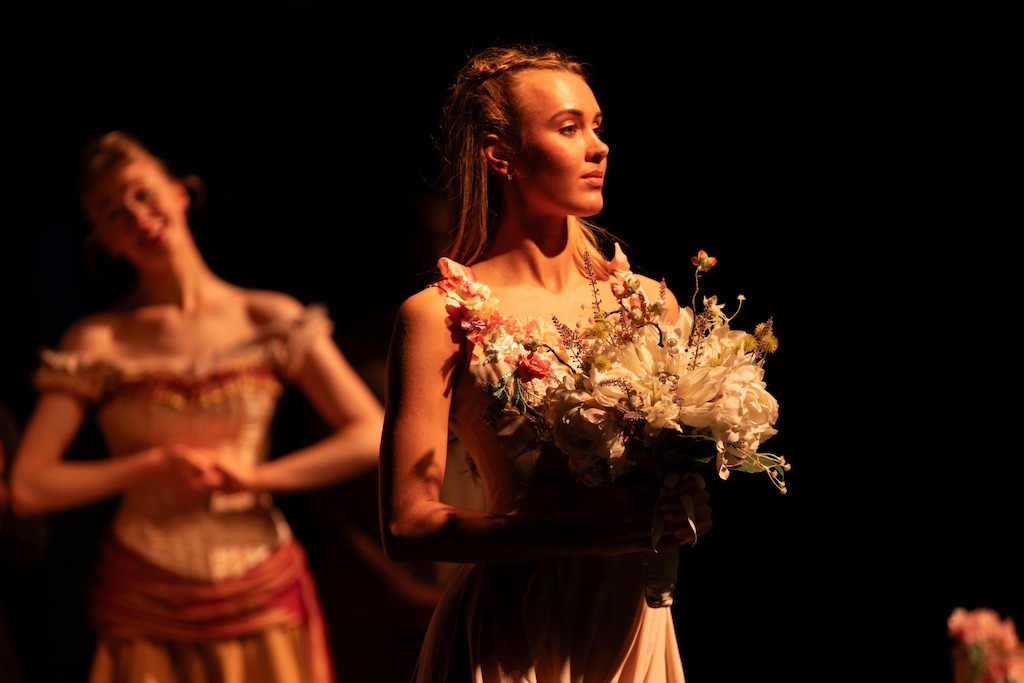
Director and Choreographer: Kevan Allen
Coppelia is loosely based on E.T.A. Hoffmann’s dark, psychological tale, Der Sandmann. Repurposed as a comic ballet multiple times, this production of a widowed inventor’s creation of a mechanical doll to fill the void left by his wife is one of the most successful in the repertoire. KVN Dance Company’s production, which opens at the Marylebone Theatre, has managed to produce a thoroughly entertaining take on this classic.
From the first scene, the production pulsates with Tim Burtonesque eeriness. This is driven by the crazed figure of Dr Coppelius (Michael Downing), whom we find searching for the final cog to fashion his doll.
A major innovation of these opening scenes is how the choreography of the ensemble cast serves to, at times, embody, and at others demarcate between, the doctor’s psychological turmoil and the carefree cavorts of the townsfolk in the square. A vital component of this innovation, which extends throughout the whole performance, is Rickard Berg’s adaptation of the score.
Berg counterpoises Coppelia’s classical armature with various nods to more electronic, contemporary genres, which in turn set the tone for the dynamic range of dance styles deployed throughout the performance.
The casting choices are excellent from the svelte Pumpernickel couple (Oliver Imeson & Sophie Tierney) to Rosie Southall’s remarkably believable performance as Coppelia. Zach Parkin’s Franz, a young man who finds himself infatuated with the image of the doll, is equally compelling. But it is Ellie Fergusson’s portrayal of Swanhilda, the youth who follows Franz in the hope of ridding him of this infatuation, which borders upon show-stealing. She balances the shifting emotionality of her famous character—from youthful innocence to jaded envy to poised elegance—with utter aplomb.
The scene in which Coppelia first comes alive is particularly worthy of note, as Berg’s score playfully flits between a pulse-like baseline and string-based counterpoint (perhaps evocative of a marionette, playing upon the central question of the doll’s ontology and existence). Wendy Olver (costume design) is especially effective here too, as the process of clothing the doll also captures the liminal identity inherent to Coppelia’s aesthetic otherness.
Perhaps the most thought-provoking moment of the ballet, however, is the portrayal of Coppelia’s placement in the window of the doctor’s shop in the square. This action is built into a scene change in which the silhouetted townsfolk are seen rearranging the stage, as Coppelia remains the single subject, beautifully downlit in the centre of the square. The shifting stage brilliantly mirrors the mechanical movement of Coppelia herself, as she twists into place, blankly staring the audience down until a book is placed into her hand.
This scene change also adds a dimension to the ballet’s central question — that of the doll’s impact on the broader psychological atmosphere of the town itself. The programme notes Allen’s longstanding confusion at the classical production’s portrayal of the townspeople readily accepting ‘a life-sized clockwork doll being placed in a window.’ Here, by having the townspeople physically rearrange the context in which Coppelia is seen, Allen appears to tackle this crux by blurring the ballet’s constitutive boundaries of reality and fantasy. Perhaps then the defining quality of this adaptation is its capacity to touch upon the multiple angles from which one may both perceive the position of the doll and the society in which she is formed.
In all, despite a few ponderous moments in the first half in which the attention given to merry provincial scenes feels overlong, the production is deeply entertaining. Allen and his company are unafraid of straying into anachronism when it has the capacity to innovate or enhance the effectiveness of a scene. From choreography to composition and costume, such innovations have been applied to great effect. The result is a revitalisation of a classic.
Runs until 27 April 2024 and continues to tour
