

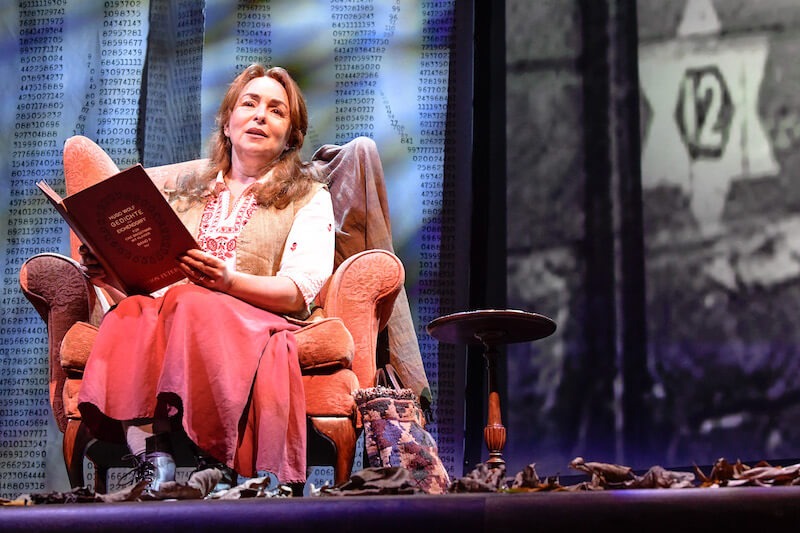
Writer: Jean-Claude Grumberg (Translated by Nicolas Kent)
Director: Nicolas Kent
Marylebone Theatre commemorates Holocaust Memorial Day with a dramatic reading of Jean-Claude Grumberg’s 2019 bestseller The Most Precious of Goods translated by Nicolas Kent who directs it for the stage. This 75-minute performance focuses on the importance of storytelling bringing the tale to life through the vocal talents of the narrator Samantha Spiro with occasional musical accents from cellist Gemma Rosefield who find the humanity and hope in Grumberg’s short story.
Packed onto a train in early 1943, a Jewish father makes the terrible decision to throw one of his baby twins through the bars where she lands at the feet of a woodcutter’s wife. Believing this to be a gift from God, the woman cares for her, even convincing her sceptical husband to eventually love the child. But the war continues around them, and the girl’s real father believes he will never see his daughter again.
Kent has done very little to alter Grumberg’s story, allowing the original structure and approach to speak for itself as the story unfolds along two parallel tracks – that of the original Jewish family taken to a concentration camp and the woodcutter’s happy family in pastoral France. These narratives intersect throughout, and Kent uses music to facilitate the segues between them as cellist Rosefield generates tension and drama but also lullaby melodies that underscore points in the developing story.
The Most Precious of Goods has a parable quality in both Grumberg’s writing and Spiro’s reading, a story that feels both real and fantastical at the same time, taking place in the grim experience of the Holocaust and in the isolated and protected world of the French forest. Occasionally these two strands overlap, with violence and danger invading even the happiest of moments, but Grumberg also provides opportunities for optimism and recovery after the darkest experience of war.
Spiro’s approach is engaging, using a variety of vocal tricks to maintain the pace of the story from character voices to shifts in emphasis, tone and delivery to suit the different plot requirements as well as the changing experience of both families across the months and years that Grumberg covers. Spiro is a particularly empathetic narrator, something which often imbues her performance style, and here draws the audience into the lives and needs of these connected strangers and the horrifying circumstances they are part of.
Director Kent applies a changing photographic backdrop selected by Judy Goldhill to prompt scene changes, but The Most Precious of Goods is not inherently theatrical. For the most part, Spiro remains seated in an armchair and reads the story from a bound book, occasionally standing or using a shawl as a prop, which makes it a little cosier than perhaps it should be. There is beauty and love in this story but also terrible deeds, bigotry and murder that demand a starker visual approach, but this is a hopeful tale for Holocaust Memorial Day about the kindness of strangers and the good that can come from evil.
Runs until 3 February 2924
