

Writer: Michael Healey
Director: Jimmy Walters
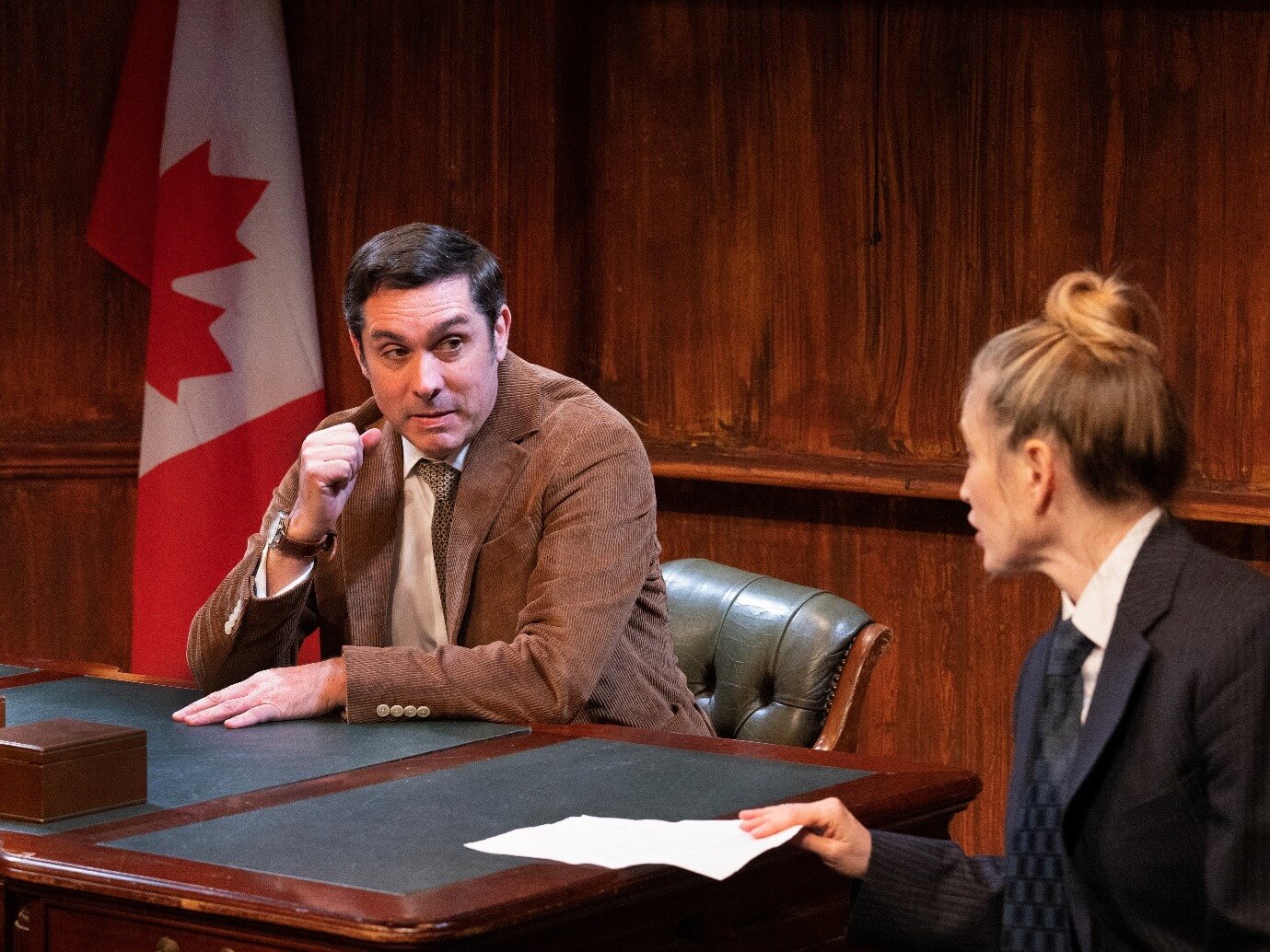
1979 is one of the most notable years in modern politics and few, even now, can remember it with any equanimity but Britain wasn’t the only country to face a nation-changing year. The European premiere of Michael Healey’s play at the Finborough Theatre documents a single crucial day in the government of Joe Clark, Canada’s Prime Minister of only 6-months who debates the nature of democracy, the purpose of leadership and his own belief in how the game should be played while facing what is likely to be certain defeat for his first budget.
13 December 1979 and the Progressive Conservative government is about to face a big vote in the House of Commons, a test of its leadership and ability to wrangle support for its minority administration. But everyone tells Clark he is going to lose and should just buy time by delaying the vote. Across the hours before the bill is presented, guests including serving ministers, ex-leaders and even Clark’s wife come to have their say, but will it make any difference?
A minority government clinging on by its fingertips, the machinations of Parliament, ailing members unable to make the vote and a pervading air of panic around the political gameplaying, you might have accidentally wandered into James Graham’s This House which took its minority government up to the same year, but 1979 isn’t quite as snappy as its predecessor, not quite so accomplished in weaving expositional context around the central story. Healey’s play instead adopts a much blunter tool, projected information which not only notifies the audience who the characters are but also provides background details on them and even the outcome of this budgetary event long before the play’s conclusion.
But the approach proves a frustrating one, often overlaying these notices when characters are talking distracting the audience from one or both. And although they acknowledge their own length in a good-humoured asides, the excessive length of notes in the latter sections is cumbersome and heavy-handed – there are better and more dramatically satisfying ways to inform the viewer of these outcomes and biographical sketches. Here, perhaps Healey might borrow a little from Graham on how to blend an entertaining story with detailed historical research.
The play is structured around a number of long duologues in which Clark explains his position and allows others to assail him with their views. There are some strong arguments in here, and 1979 seems particularly concerned with establishing whether Clark was the most incompetent or most integrity-driven leader Canada has had in the modern era.
Healey never settles on a firm conclusion, nor does his central character ever seem to waiver in his firm ‘do nothing’ policies that sucks some of the fire from these exchanges, making them seem more like Dickensian visitations from colleagues in a make or break situation. But there is some interesting constructions in here, even the zealous advocation of Thatcher’s election by the semi-fictionalised mailman that says something about short-term political optimism, even if the play doesn’t recognise the long-term consequences.
Performances have a sitcom feel, light, loud and often played for laughs with the hard-working Samanatha Coughlan and Ian Porter performing multiple different characters and genders. The tone becomes a little booming at times with Joseph May’s Clark exclaiming in his own defence quite often, and while May presents a likeable, fairly ordinary man, the writing gives the actor little but placidity to build the performance around with few places to go dramatically.
1979 has lots to say and has some thoughtful philosophical reflections on the nature of leadership, policy making and the political game, but a longer piece perhaps with multi-character scenes might bring some of that heavy exposition into the story and show us why Clark and 1979 are so vital to Canada’s political experience since.
Runs Until 27 January.
