

Writer: Reginald Rose
Director: Christopher Haydon
It’s the hottest day of the year so far and twelve men have already spent three days in a stifling  courtroom listening to the evidence mount up that a sixteen-year-old boy stabbed his father. The case seems open-and-shut: the boy is from the wrong side of the tracks; he and his father have a difficult relationship; and, of course, there’s the damning evidence of the eyewitnesses.
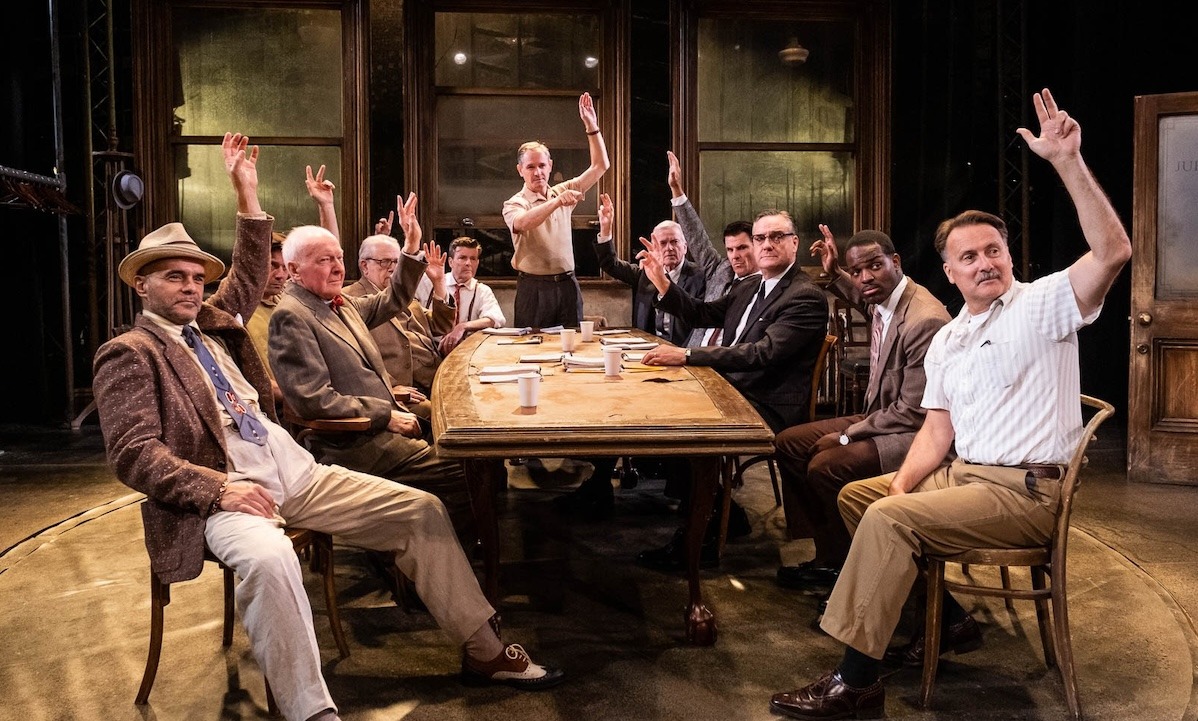
We join proceedings as the judge ends his closing remarks – reminding the jury that, among other things, should they reach a verdict of guilty then the accused will certainly go to the electric chair. The men are led to the deliberation room – and locked in. After exploring their surroundings, a rather drab monochrome 1950s meeting room, they eventually settle. It’s open-and-shut, right? So they take a vote. No point wasting time, and one juror has an urgent appointment at that evening’s ball game. But another juror isn’t yet sure. The first vote is overwhelming, eleven for guilty, only one dissenter – and the verdict must be unanimous. And so the unassuming Juror Number 8 leads his peers in forensically examining each piece of evidence and challenging prejudices and stereotypes. Along the way, we find jurors who need to deal with their own preconceptions about ‘these people’ as well as those whose own experiences and background colour their judgement. And we learn how honest witnesses could be mistaken. Can Juror Number 8 cast enough seeds of reasonable doubt to acquit?
Michael Pavelka’s set design perfectly sets the mood, feeling stifling even on a cool October evening and giving Juror Number 8 the opportunity to turn the tables, although the sound balance on this occasion allowed the cast’s footsteps to occasionally be overamplified. The costumes perfectly evoke the mid-1950s. While each juror only has a number, aside from the foremen, they do each have their own characteristics and, as the play moves on, we can infer something of their backstories. Christopher Haydon’s direction lets the pace ebb and flow: at times frenetic as jurors give their opinions quite forcefully; at others steady as jurors absorb the arguments, turning them over in their minds. There is an ever-present undercurrent of tension that, on this sultriest of days, one could easily imagine cutting with the knife the accused allegedly used.
This is certainly an ensemble piece and each cast member adds to the proceedings. Attention focuses on Juror Number 8, played with superb understatement by Patrick Duffy as he challenges his peers to test the evidence. He is introspective and calm, the very voice of reason, just occasionally becoming sufficiently riled to raise his voice. Ben Nealon and Gray O’Brien are forthright in their belief of the accused’s guilt, while Paul Lavers and Paul Beech give a masterclass when quietly hinting at their own backstories.
This is a play that demands the audience’s attention: it’s wordy but there simply isn’t any slack in Reginald Rose’s tightly written script – each word is included for the job that it does. But it will repay the effort as we see action and reaction time and again from a company of incredibly skilled players, heartfelt monologues laying bare each character. And while the set and costumes might be dated, the issues faced in judging innocence and guilt, and in dealing with our own preconceptions, have not.
Runs until 4 November 2023 and on tour
