

Writer: Tom Wright
Director: Stephen Bailey
What do we really know about Joseph Merrick, otherwise known as the Elephant Man? Alongside  some of his background, we have some details of the treatment he was given which were written by the surgeon who was responsible for him spending his final years in hospital, and that is pretty much all. Above all, there has traditionally been a fixation on his appearance. What we don’t have is Merrick’s own perspective, his own thoughts and feelings.
This is where The Real and Imagined History of the Elephant Man comes in, putting Merrick at the heart of his own story, imagining what he was going through. Here is a man who finds himself forced to use his body as an exhibit in order to survive. When his disability makes him unable to work, he turns to the circus until worsening health pushes him towards the medical profession who, rather than offering him care, seemS more interested in pursuing the same theme, as an anatomical anomaly to be investigated and gawked at. Even now, over a century after his death, Merrick’s skeleton remains on display in a glass box.
This European premiere of Tom Wright’s play is a powerful piece of theatre with a cast of six composed of Deaf, disabled and/or neurodivergent actors, who are able to bring their lived experience of disability to the understanding of the story. Using deliberately provocative ableist and discriminatory dialogue that some audience members may find disturbing, it highlights attitudes towards a man who is fighting for acceptance in a world that eschews any positive recognition of diversity. It doesn’t attempt to present any sort of realistic representation of Merrick’s appearance, using no prosthetics. Instead, Zac Ford-Williams (Joseph Merrick) adjusts how he masks his Cerebral Palsy to show Merrick at different ages as his body changes. It’s a good performance from Ford-Williams, who gives Merrick a dark humour alongside a stoical acceptance as he faces what has become, for him, the reality of life.
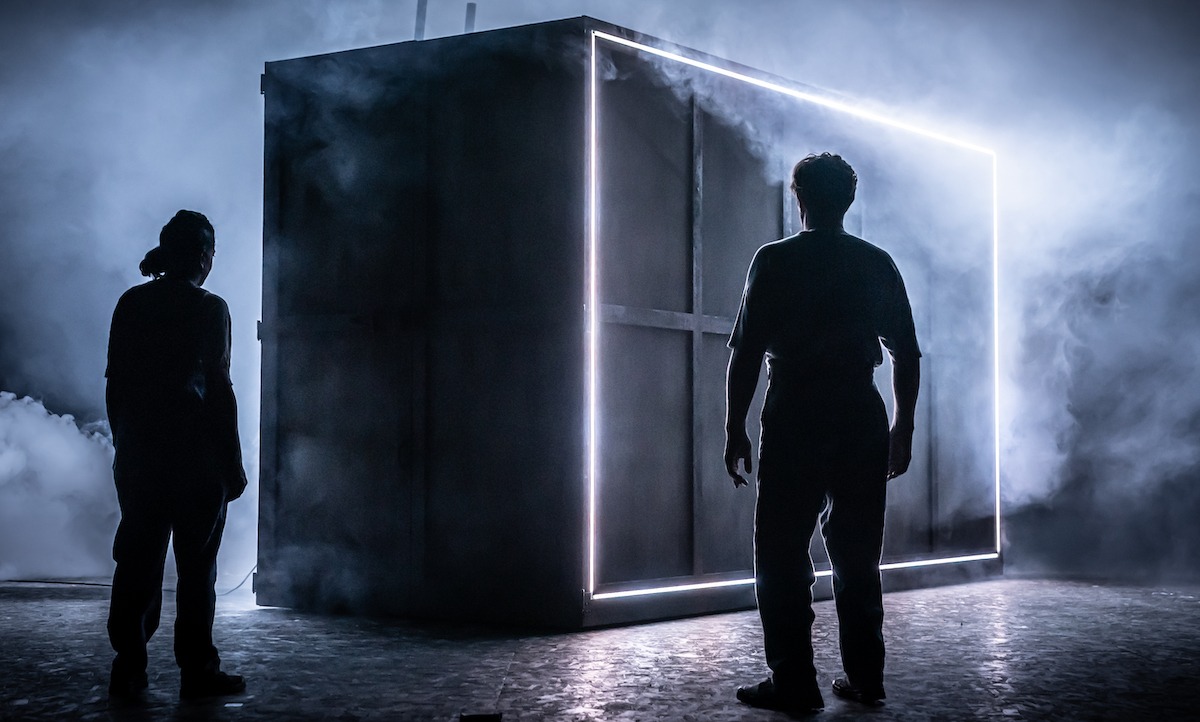
Ford-Williams is supported by a strong cast covering a variety of roles as the piece progresses The set by Simon Kenny gives us a nice representation of industrial London, a large box dominating the stage reminiscent of the boxes historically used to transport circus animals around the country, a reference to the sideshow exhibit that Merrick becomes. Later, we’re in the basement of a hospital – more clinical maybe, but still essentially a box, as Merrick reflects on whether it is to protect him or to protect others from him.
Using a combination of spoken dialogue, signing and captioning (all performances are captioned and audio-described) the discrimination and attitudes that Merrick had to deal with are laid bare for us to see. This is not an easy piece of theatre to watch, that makes you realise how much has changed but at the same time warns against a feeling of smugness in what has been achieved to promote accessibility and inclusion – far from ‘look how well we’ve done’ this has you leaving the theatre with a greater understanding of the realities of life for disabled people, even today, and how much more there is still to do.
Runs until 7 October 2023 and on tour
