

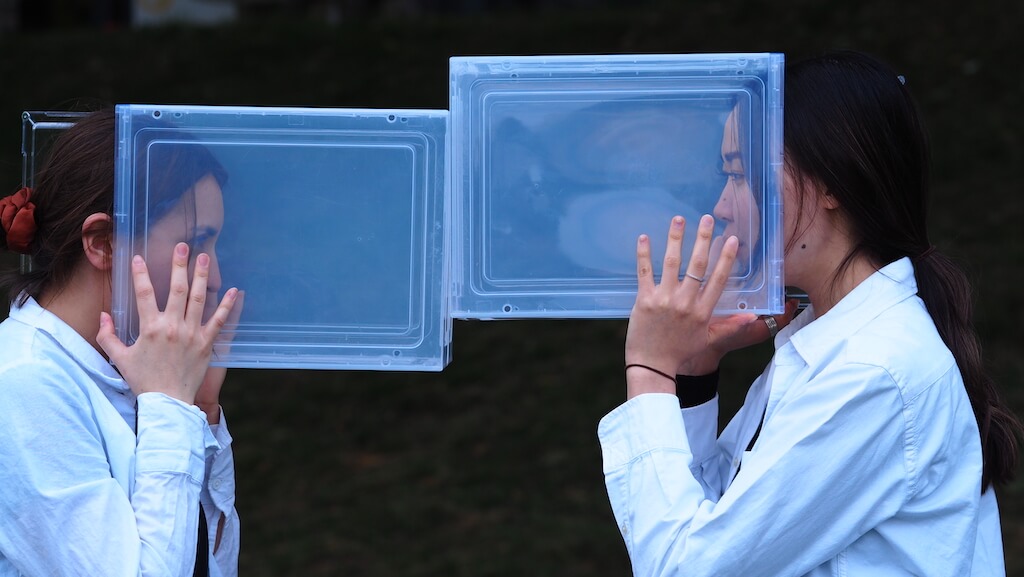
Creators: Bodies for Rent
Directors: Moses Hao and Jiazheng Li
Creating a dramatic work based on a short story by Anton Chekhov is a tricky endeavour. The biggest challenge is that even by short story standards, Chekhov’s could be particularly brief.
The Chorus Girl is one such story. It tells of Pasha, the chorus girl of the title, being confronted by the wife of Nikolai Petrovich Kolpakov, one of her gentleman admirers. After the irate wife informs Pasha that her husband is an embezzler and leaves, the chorus girl turns to Nikolai for comfort, only for him to verbally abuse her and run back to his wife.
There’s not a huge amount, then, on which to hang an hour of theatre. But it is the starting point for Languageist, a devised work by Bodies for Rent looking at the relationships between three people and the effect language can play.
The trio of players, all dressed in black, initially play Chekhov’s story fairly straightly. Stephanie Arkinstall’s Pasha is a warm contrast to Aijamal Nova’s spikily abrasive visitor, while Jun Noh makes the vicious aspects of Kolpakov’s outbursts really hit home.
After the initial run-through, things become more abstract. The players take turns to remove a white shirt from a plastic box on stage, finding ways in which to wear that in a non-shirt way: as an apron or a headscarf. Most effective is when Arkinstall wears hers back to front, giving the impression of a high-necked fitted blouse. It lends an air of renewed stature for Pasha in a subsequent repeat of Chekhov’s story. This time Arkinstall narrates in character, giving a sense of how alternative perspectives can make the same story come across very differently.
But after that reinterpretation, things get looser still. Nova leads a song and dance where the lyric consists mainly of the name “Nikolai Petrovich Kolpakov” sung over and over until the words themselves lose meaning. The trio sometimes pick up on words or phrases said by one of the others, repeating in loops to much the same effect.
As the hour progresses, the amount of content seems to stretch ever thinner until it is held together by the undoubted charm of all three actors. The plastic boxes that once contained the shirts are rearranged; ribbons of recycled fabrics attached to the Greenhouse Theatre’s central pillar are wound, unwound, and thrown. Quite what the piece is trying to stay becomes murkier, not that it was ever all that clear.
The effects of repetitious sound, singing and movement, coupled with the sounds of the Jubilee Park’s water features audible through the pop-up theatre’s thin walls of reclaimed wood, make for a gentle afternoon of theatre. But beyond that, it feels as if the idea behind the devised work has yet to fully emerge.
Reviewed on 1 July 2023
