

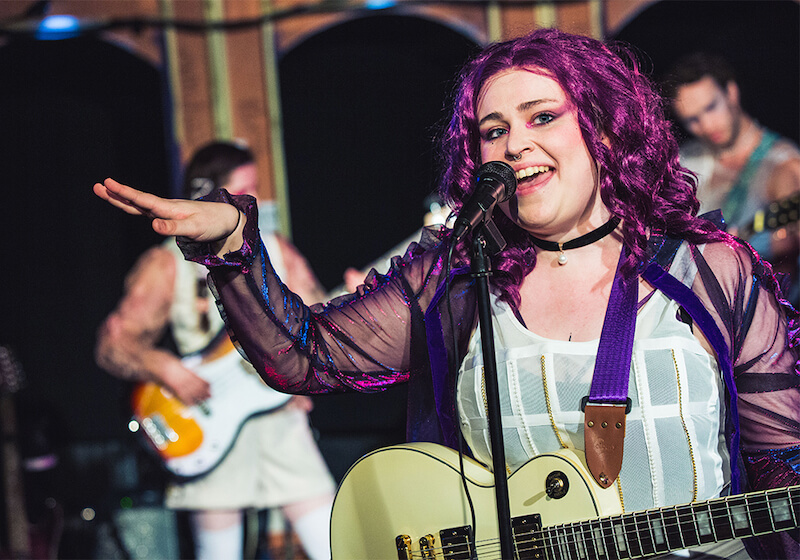
Julie: The Musical – Kings Head Theatre, London
Writer and Director: Abey Bradbury
Julie: The Musical is a charmingly camp satirical romp through the scandalous, often seductive, life of 17th-century French socialite and opera star Julie d’Aubgny. The star of stage and swordfights, if you’d believe it, is widely believed to be one of the first openly bisexual public figures in known history so a musical adaptation of her life seems an apt way to commemorate and celebrate her contribution to LGBTQ+ and musical history.
With a petite yet effective cast of five, the gig-theatre format of the piece sees each one of the ensemble take on countless characters from Julie’s life, all while effortlessly plucking away at a plethora of instruments that sit playfully strewn around the stage.
This performance is however an abridged one-hour version of a longer show, with the result being an ever so slightly rushed whistle-stop tour of our dear protagonist’s fascinating story. While some fourth wall-breaking and meta-commentary about the confines the performance is working under have us prepared for more of a highlight reel than a full-blown performance, certain creative choices and questionable narrative detours leave the performance with only a select few moments to achieve genuine emotional or comical punch. The exposition-heavy conclusion comes a little too suddenly and doesn’t quite give us time to see Julie or any of the lives she touched learn anything notable – something the greater runtime may create more space for.
But perhaps with historical storytelling, where a five-minute Google search could give you all the key details of a life and musical theatre alike, the pleasure is not in the careful hitting of story beats in succinct succession but in the individual moments of joy and humanity that let us relate to our characters and revel in the absurdity that is history-centred musical theatre. It is these moments this performance has in abundance.
The cast are at their best when allowing themselves to be ridiculous. Donning powdered wigs and crocheted fake moustaches, they shuffle and guffaw to form an all-male jury of legal types who try poor Julie for a string of offences including burning down a convent and running off with a fellow nun. The gender satire here is warm and politically sharp as the five pardon Julie for her crimes in a barber-shop quartet harmony of “Lesbians don’t exist”, a comical highlight of the show.
While Sam Kearney (they/them) is a strong set of lungs and reliable central presence as Julie, they are outshone by co-star Georgia Leila Stoller (she/her) who finds a way to steal most scenes she is anything more than a background harmony in. Swaggering out early in the performance as a male fencing instructor and the first of Julie’s many lovers, Séranne, Stoller’s hypersexual hypermasculine stage presence lets you laugh with her at the leering lothario archetype. Her immense range and acting ability are then cemented when she drops the male facade and performs instead as the timid and tortured Madame la Marquise de Florensac, the then “most beautiful woman in France” and yet another one of our protagonist’s notable lovers. Stoller’s heartbreaking ballad as the Madame stands out as the most tender and layered performance of the night.
Fabian Soto Pacheco (he/they) also becomes many faces throughout the performance and while their delivery and presence don’t match that of Stoller, it is their outstanding vocals that prove them as a voice to watch out for in musical theatre circles. Pecheco’s impressive range in For The Love of God has you confident that in any songs which proceed this point, it is them you’ll be listening out for.
With this said, for a show which centres on a famed opera singer and includes heavy reference to opera as an art form, the show does lack operatic vocals and the musical accents that go along with it. This, even in a small quantity, would have situated the piece in the musical period we are to believe it is set and elevated the sometimes a-bit-too-musical-theatre-ish soundtrack to a more altogether unique listening experience.
Yet, despite certain lacking elements, the performance still manages to deliver a joyous celebratory account of a sensational scandalous life. The cast’s continual gender-bending and raunchy romantic romps put the play firmly on the map of notable queer theatre that every she, gay, and they should go out of their way to see. The instrumental and theatrical talents from the ensemble make the performance an upbeat pleasure to behold and leave you wishing you had more time with the singing seductress and her cast of comrades; something you may well get if you go along to the full show at The Other Palace in late July.
Runs until 10 June 2023 and the full show runs at The Other Palace, London, 25-30 July
