

Writer: Fatrick Tabada
Director: Percival Intalan
I Love You, Beksman, opening this year’s Queer East Film Festival, is a camp and vibrant look at modern-day masculinity. It’s fun and fresh, but its reality TV sheen suggests that the film’s real home is on E4 or BBC Three.
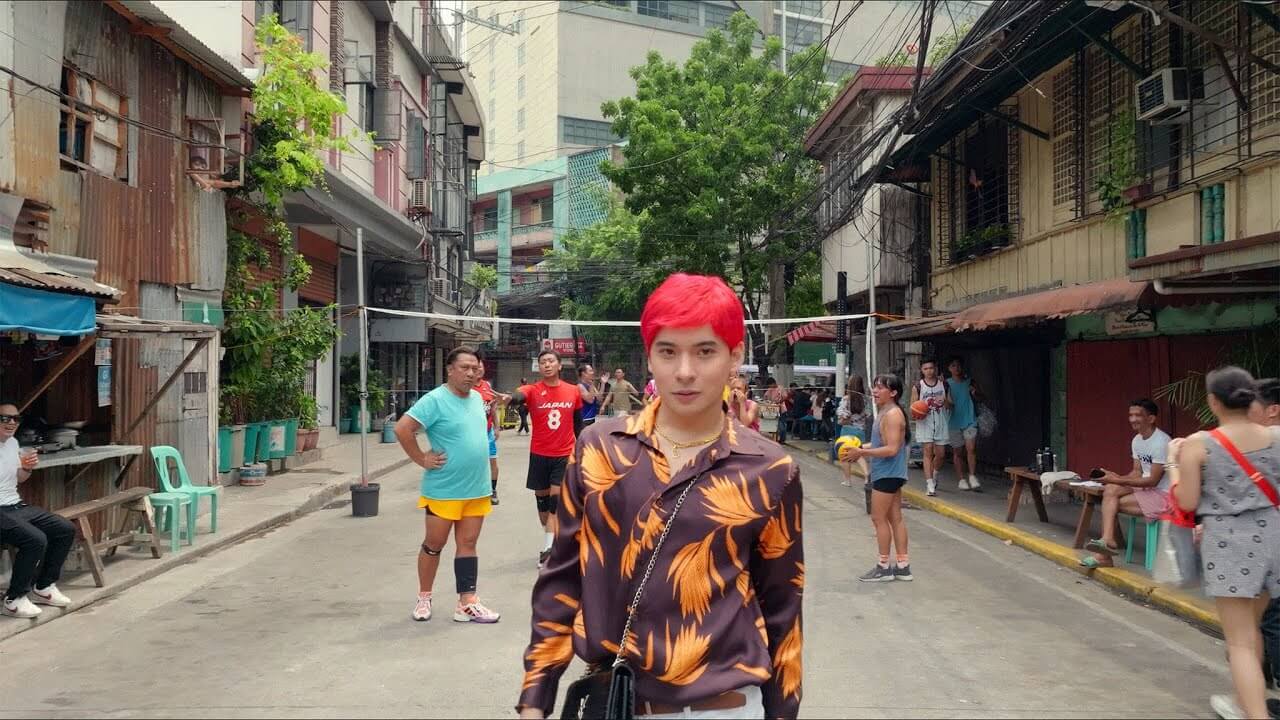
Set in a pastel-coloured Manilla where everyone seems to be queer, Dali is the only straight in the village. However, he doesn’t adhere to traditional displays of heterosexual masculinity with his flashy clothes, make-up and metallic orange-red hair. And he’s camper than Freddie Mercury, Elton John and Harry Styles rolled into one. No one believes he’s straight and when he announces that he’s in love with beauty queen Angel his friends roll their eyes to a chorus of ‘As If’. Jaime, the matriarch of the house and, also, Dali’s biological father, says that Dali is too talented to be straight.
Dali is a make-up artist and fashion designer working in his parents’ salon where every employee is queer. It’s a queer utopia and each evening everyone sits down to eat together like the queer families of colour – houses – in 1980s/90s New York, recently depicted in the TV show Pose. Even the streets outside the salon are full of queer people. Every time Dali leaves the shop, a queer volleyball match is being played and whenever the ball is thrown to him, he fails to catch it.
At first, Dali seems to be content to let everyone else think he’s gay. His friends call him ‘Girl’ and ‘cissie’, but these words seem common parlance in this part of the Philippines. Indeed, the film’s title is an amalgamation of beks, slang for gay man and peksman, which means promise in Tagalog. Percival Intalan’s film is alive with scintillating colloquialisms, a lot of which is lost on those who can’t speak Tagalog.
When Dali meets Angel at a beauty pageant he falls in love and, in order to court her, Dali decides that he will become more masculine; Out go the flamboyant clothes and in come the sensible polo shirts; make-up brushes are put aside in favour of dumbbells and the old exclamations of ‘Girl’ are swapped for ‘Bro’. This segment of the film charting Dali’s transformation proves to be very funny, especially when male heterosexual rituals are revealed to be very silly.
As Dali, Christian Bables effectively plays two roles; the impossibly fey make-up artist who can tell the difference between hundreds of similar shades of foundation and the wannabe alpha male who consults YouTube tutorials before agreeing to play basketball or offering to change a tyre. That Bables is convincing in both demonstrates how good an actor he is, and he certainly carries the film through its sentimental sections.
It’s these melodramatic scenes, played out to songs about being true to oneself, that definitely imply that the target audience is a younger one, despite the occasional adult humour. Any swear words are modestly given asterisks in the English subtitles, but some of these dirtier jokes are glimpses of a film that could be a little smarter, a little more complex. As it is, I Love You, Beksman is too cheery for its own good. But this utopic vision of a world, where coming out as straight triggers disappointment and disbelief in one’s family and friends, is a nice reversal of the world today.
Queer East Festival 2023 takes place 18 – 30 April across venues in London. For further information: https://
