

Writer: Michael Punter
Director: Jane Richardson
The particular dangers of the online world are a difficult thing to dramatise on stage, often requiring screens and elaborate set designs that can be beyond the reach of fringe theatre productions. Shows like The Nether or Public Domain are costly to stage if they are to have their desired effect, so credit to new theatre company Tricksy Spirits which aims for ‘low-tech and high-impact work’. Its production of Michael Punter’s BOOKOO PHISH sets aside the expectations for plays that the Internet brings and instead focuses on the human relationships facilitated by online interactions.
A scammer calling himself Timothy Watson and claiming to be from Boston hacks a middle-aged lady’s computer somewhere in the southern states of America and then calls her in the guise of tech-support, demanding a credit card payment to download a security programme. But Peggy is a chatter and, easily distracted; she talks to Timothy about his family, her life and her staunch religious beliefs, all the while failing to enter the vital financial details Timothy so desperately needs.
Bookoo Phish is an intriguing 60-minute duologue that plays with the audience’s expectations. What could be a legitimate call only becomes suspicious when Timothy makes some whispered asides, commenting on the irritating character of his victim. As Peggy dallies, Timothy’s irritation is stark and Punter slowly breaks down the smooth, easy-going character identity that this scammer has adopted and introduces both his temper and a tendency to violence that make him increasingly dangerous.
Some of that is contextual. The introduction of a backstory for Timothy adds some urgency to his need for the money, giving him another interaction point with someone outside of this conversation, but the slow loss of control that erupts into a threatening outburst is well managed. Peggy is a great and carefully written character, given a verbosity and ability to distract the conversation that is actually quite skilled, sometimes refusing to answer Timothy’s questions which leaves the audience to wonder what she also might be hiding.
The premise does begin to stretch a little later in the hour and once the audience has heard her obfuscation and distracted conversational style, the requirement for some kind of resolution or pause lingers for a while before Punter addresses it. There is also a last-minute switch that could be better explained, particularly the scene in which Timothy calls Peggy for a second time and she cannot remember their conversation. Is this affectation, absent-mindedness or something else entirely? It’s never clear enough why this is included in the story other than another reason for Timothy to be annoyed with her.
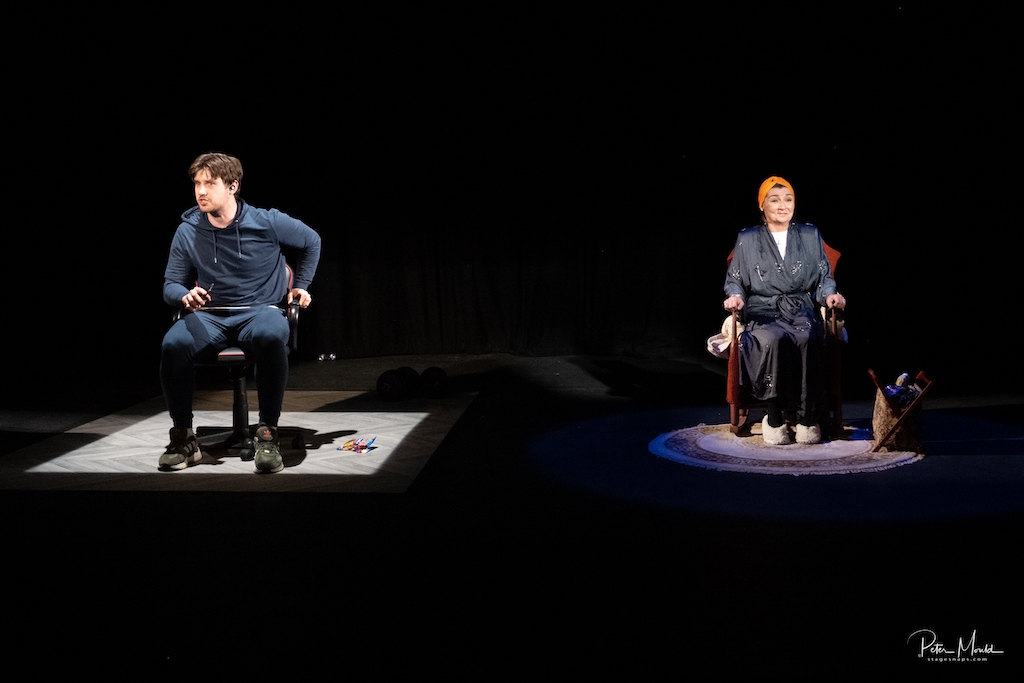
James Crouch’s Timothy is ultimately quite a nasty piece of work but Crouch plays the Jekyll and Hyde identities well, the charming Bostonian who reassures the worried client that he can save her files and the calculating predator with a vicious streak that sits underneath. Rachel McCarron has a harder role as Peggy and most of the lines to learn, but she too captures the innocuous sweetness of her Southern Belle who believes in God and enjoys chatting to the nice young man who will save her day.
The low-fi approach works well. With two chairs and no tech whatsoever, Jane Richardson’s production does more than enough to imply that two strangers are on the phone to one another and connected online without needing to show that, freeing the actors to concentrate on the performance. BOOKOO PHISH arguably has one fatal flaw, that if Timothy was so desperate to make money quickly he would have feigned a connection issue and moved on to another target long before the rambling Peggy settled in for a long chat, but it has interesting things to say about perspective and truth online and how careful we need to be before opening our computers and bank accounts to strangers.
Runs until 26 March 2023
