

Writer: Mojisola Adebayo
Director: Matthew Xia
In 1951, a black woman, Henrietta Lacks, died in Baltimore. She was being treated for cervical cancer which had been confirmed after a biopsy. The cells taken from her for the biopsy were cultured in the lab and had a remarkable property: provided with nutrients, the cells divided quickly and could survive and divide  outside the body indefinitely – most human cell lines die within a day or two. Production of her cells, designated HeLa, was industrial in scale and they were, and continue to be, used commercially for medical research – for example, in the development of the first polio vaccine. But, crucially, consent to harvest and exploit her cells was never sought – this was not unusual in 1951 and as late as 1990, a US court ruled that ‘discarded’ cells and tissue no longer belong to the donor and can be commercialised.
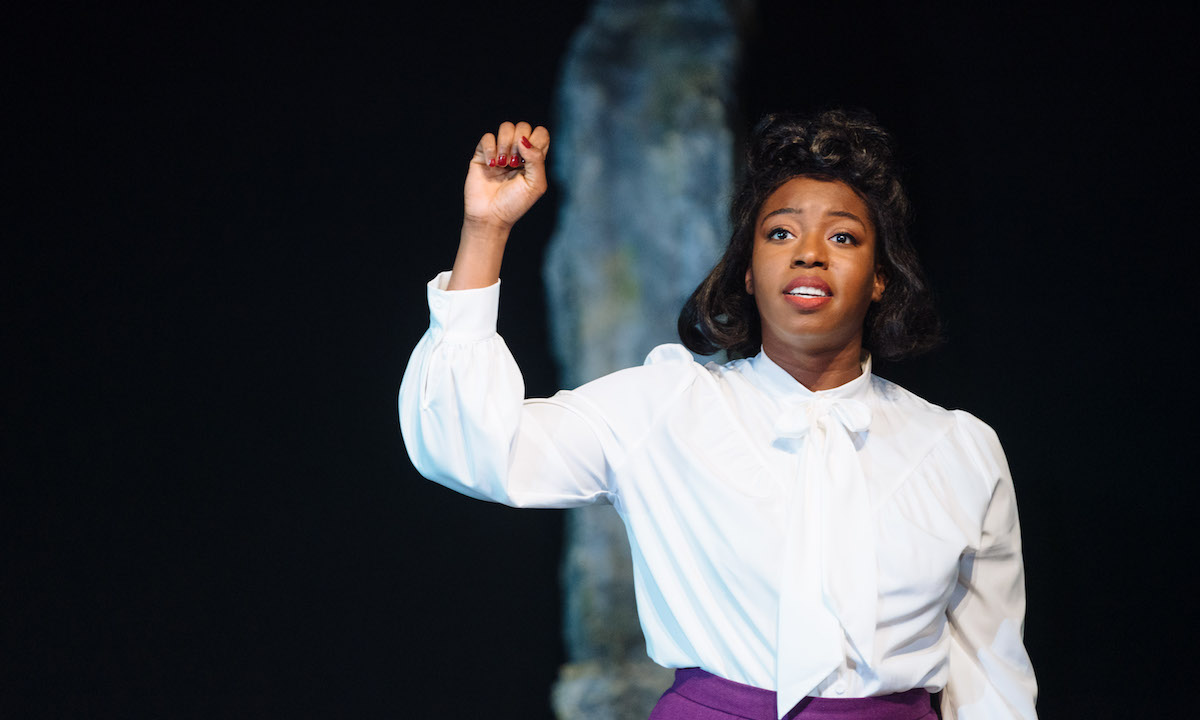
While Lacks’ story is at the centre of Family Tree, it is but one example of the treatment and exploitation of the black diaspora. Aminita Francis brings us the immortal Lacks as she tries to make sense both of her life and the life her cells continue to enjoy after her death. Even after death, this woman is sassy, looking out for her family who had no idea of her contribution to medicine for many years. We also meet some NHS nurses dealing with the everyday prejudice and casual racism they encounter while doing their jobs. From their lips – largely from Ain, played by Mofetoluwa Akande, supported by Keziah Joseph’s Bibi and Aimée Powell’s Lyn – we hear bitterness at their treatment and at the lip service often paid by so-called allies. These actors also take us back in time to see the experiences of black slaves – the stock from which Henrietta sprang. And the long and ominous shadow of the white man is provided by the macho Marlboro man– notably a non-speaking part – silently walking across the stage as if he owns it, but eventually succumbing to cancer and death and, of course, cared for by those same black nurses at the very end.
This is not intended as a docudrama about Lacks. Writer Mojisola Adebayo has certainly used Lacks’ character as a jumping-off point in her writing, but it is really a polemic against toxic racism and exploitation in all its forms. The casual way that Lacks’ cells were used for so long without any recognition is used as a microcosm of the whole black experience to set it in sharp focus alongside more contemporary examples. It does make for an occasionally confused narrative in which Lacks’ past, including her cultural heritage, and future are intertwined with the experiences and influences of the larger diaspora to bring a powerful message about the importance of mutual respect – and how often it fails to be present. Director Matthew Xia uses the pace of the production and its changing foci to ensure that the audience is never quite at ease – it is undoubtedly a wordy piece with soliloquies interspersed with quick-fire dialogue: one must concentrate throughout to get the most out of it as the focus shifts between the different groups depicted.
The set from Simon Kenny is stark and monochrome with a representation of the family tree of mankind, its branches recalling the double helix that forms the DNA of all living organisms. This vision is complemented by the lighting design of Simisola Majekodunmi and the sound design of Francesca Amewudah-Rivers – together these come together to give a surreal, other-worldly feel to the whole as we delve deeper into the characters’ lives and deaths.
Family Tree won’t be for everyone. While the HeLa cells have undoubtedly brought about medical advances and saved lives, we’re asked to reflect on the ethical cost and the impact on her family’s humanity and privacy. But it’s not only ethical questions that are raised, but questions about a long history of thoughtless exploitation. A thought-provoking – and for many, an uncomfortable – evening.
Runs until: 18 March and on tour
