

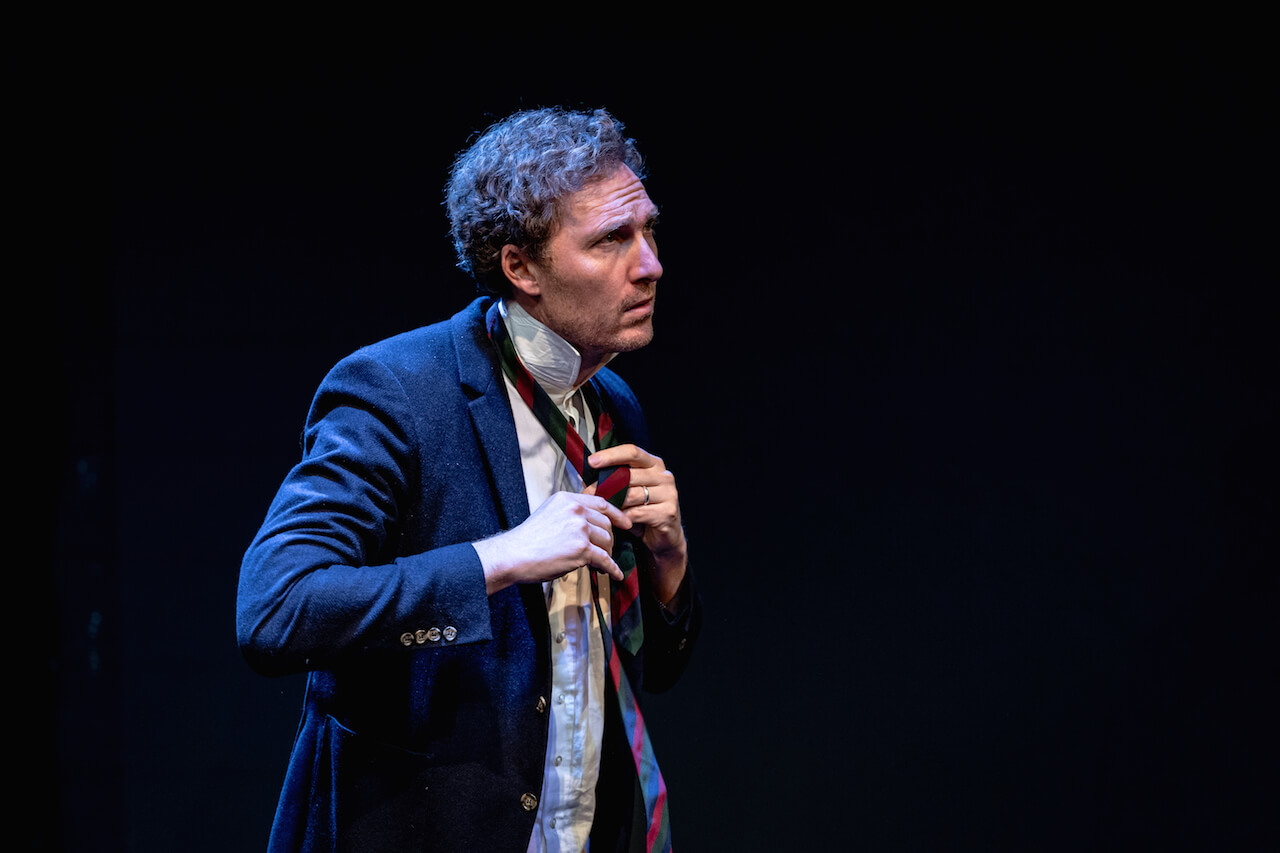
Writer: Sam Hoare
Director: Romola Garai
In this week’s Press Gazette, the industry journal revealed that a new survey found trust in journalism has increased over the last year. This sounds promising until you realise that only 29% consider the profession trustworthy – one percentage point ahead of estate agents, and five below private landlords.
Matt, the man at the centre of Sam Hoare’s Press, would seem to be the sort of hack whose very existence verifies such figures. Initially presenting us with a personal story combining marital infidelity, the death of a beloved pet and a pickpocketing offence, he quickly reveals that’s not his story at all – it’s one he’s purloined and embellished, changing the salient features for more salacious ones.
Just how tabloid journalists work, in fact. Hoare plays his character as a man who knows he’s a guileless twerp and uses that in his favour. While his parents and girlfriend (and later, wife) object to the moral and ethical vacuum at the heart of his work, he continues onward.
Matt has a modicum of charm, but the unctuousness and sleaze become harder and harder to ignore. Matters come to a head on two fronts. First, there is a public inquiry about the role of the press – the name Leveson is not used, but the inference is clear – which points out the shortcomings of the press but which ultimately fails to do anything.
There is also a particularly grizzly murder case, where a schoolgirl’s death appears to be attributable to a classmate. As if Matt’s techniques to acquire conversations with fellow pupils weren’t hellish enough, they are then constructed, and reconstructed, to fit whatever narrative will best sell the paper – with no regard to the damage to the community at the heart of the story.
It is after these events, as a now dismissed Matt seeks to make amends for his past behaviour and decides to put his journalistic abilities to better use, that Hoare’s writing derails itself slightly. As the character moves away from the tabloid world we all know, he paints a picture of a near-future Britain where a fascist regime capitalises on anti-minority sentiment to distract from its own failings.
The intention is clearly to paint a picture that is allegorically similar to many authoritarian regimes around the world, where journalism is venerated and feared for exposing the truth instead of mistrusted for telling lies. And while that’s far from a worthless endeavour, the half-hour which has gone before just cuts Hoare’s loftier goals off at the knees.
Hoare’s writing and acting do their best to provide a sense of continuity, and that he very nearly succeeds is commendable. But this play tries to tell two very discordant journalism stories with the same character. Sadly, as a result, it fails both.
Continues until 10 December 2022
