

Writer: Grace Joy Howarth
Director: Anastasia Bunce
Kazimir is a recent immigrant to the UK from Ukraine, his wife and four children waiting in Poland for him to have earned enough money to bring them over. But despite being a trained veterinarian, the only work he can get is in the local abattoir – killing animals instead of saving and caring for them.
From the off, the backbone of Grace Joy Howarth’s Blood on Your Hands is the friendship Leyov Stolz Hunter’s Kazimir strikes up with coworker Dan (Phillip Jones), a 25-year-old who has been working at the abattoir for years. Dan’s work hyperactivity and relentless chattering is an effective counterpoint to Hunter’s Kaz, a reserved, gentle giant of a man. Both Hunter and Jones create strikingly rounded, likeable characters from the off.
Some of each character’s backstories are fleshed out with glimpses of their previous life – Kazimir meeting his wife Nina (Anastasia Aush) as they share dreams to move away from their rural life, to Kyiv or beyond, and Dan sharing a chicken bucket meal with his girlfriend, Megan Louise Wilson’s Eden, who in the present is now his ex and the leader of a vegan protest group targeting the abattoir.
But it is in the present where Howarth is most invested, as Eden’s protest escalates from standing outside the processing factory and occasionally holding up lorries to breaking in and causing damage. While Eden never feels like a fully realised character either on-page or in performance, the effect her actions have on Kaz particularly – triggering some kind of post-traumatic response – has the potential to be far more interesting.
However, neither that nor any other strand is explored in any great depth. By bouncing around the central characters’ timelines the audience becomes invited to look in too many directions – and whichever one we focus on, there is not quite enough there.
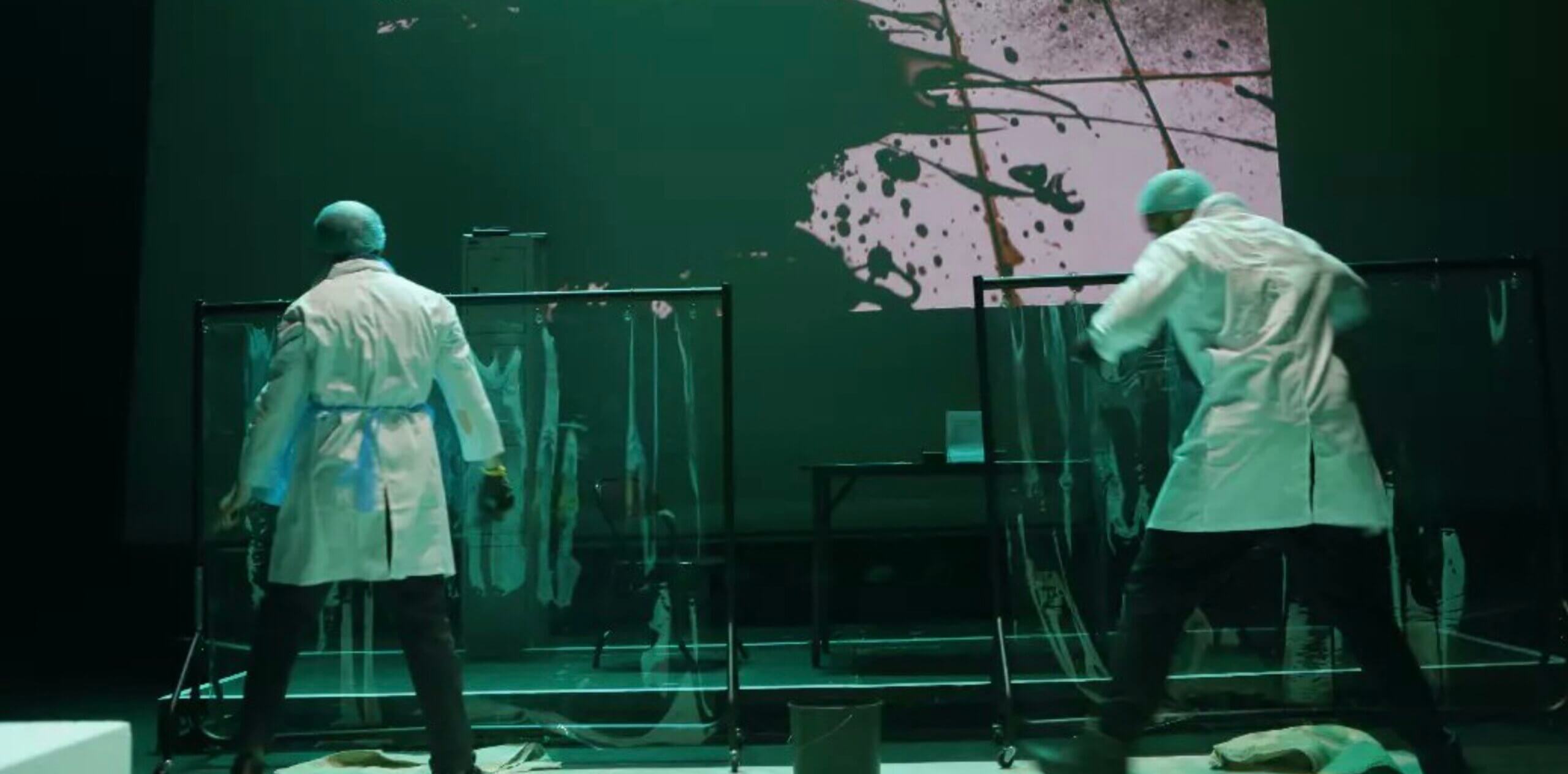
Director Anastasia Bunch stages an interesting, wordless sequence, giving us an impressionistic view of life on the slaughterhouse floor, but otherwise struggles to get the emotional core of the central characters into any sort of coherent shape.
It seems that the focus of the piece should be on the devastating emotional impact working in such an environment can have on the staff, who also have to deal with low pay and uncaring management. But Fred Rawicz’s HR manager is too broadly written and performed to be believable, and the ongoing mental health issues faced by those in the industry feel underdeveloped and insufficiently explored here. And so, when Jones’s Dan begins to pay the price for his years of service, what should have seemed grimly inevitable comes out of the blue and out of character.
It does feel as if Howarth has wanted to write a piece that highlights the plight of those working in abattoirs as one more reason why a shift to veganism would be good for all. But the lack of clarity in that goal has produced instead a bloodless work, which struggles to say anything about anything.
Reviewed on 10 June 2022
