

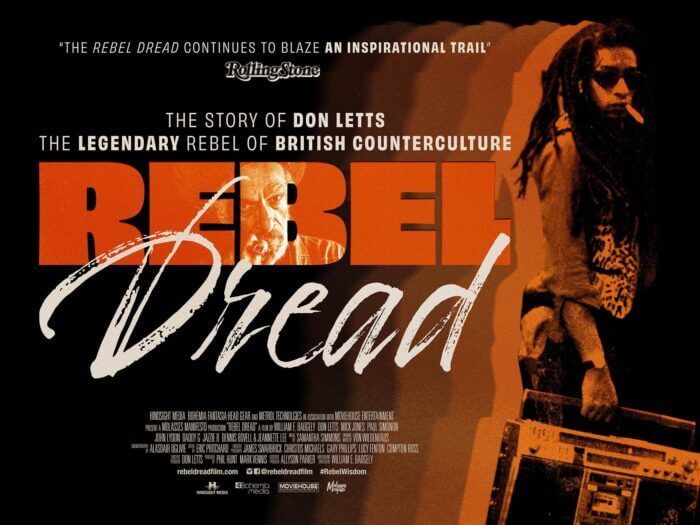
Writer and Director: William E Badgley
Punk is often thought of as white people’s music, but take a listen to The Clash’s London Calling, X-Ray Spex’s Identity and The Slit’s Typical Girls and the Ska beat is easy to hear. Punk music has its roots in the dub reggae that DJ Don Letts used to play in the Roxy, the legendary punk club in Covent Garden. Don Letts is just as much an architect of Punk as Malcolm McLaren and Vivienne Westwood. He also documented the scene and made films about The Clash. Rebel Dread, a documentary about Letts himself, is long overdue, but welcome nevertheless.
Born in Brixton to parents of the Windrush Generation, Letts had an easy childhood until 1968. It was in this year that right-wing political Enoch Powell delivered his Rivers of Blood speech calling for immigration to be reduced. The school playground changed for Letts; white boys who were once his friends now called him names. Powell legitimised racism, and Letts felt its effects.
But if his grades suffered, his commitment to style and music didn’t. He was soon running a shop down the King’s Road, selling clothes and blasting out reggae. Situated in the middle of the store was a Mod scooter underlining Letts’ interest in British youth subcultures and his determination to be part of them regardless of his skin colour. Letts once owned the second largest collection of Beatles memorabilia – before he sold it for money to buy a car.
It wasn’t long before he was hanging out with McLaren and Westwood whose shop SEX was just down the road from Letts’ Acme Attractions. The Sex Pistols’ Johnny Rotten and Sid Vicious were customers and then friends. When the Roxy was looking for a DJ, Letts was the man. And when he wasn’t playing records, he grabbed his Super 8 camera to film the punters drinking at the bar or the bands playing on the tiny stage. Of course, much of this footage can be seen in Letts’ The Punk Rock Movie of 1978 but it’s still a shock to see Vicious at the bar or Siouxsie and The Banshees performing.
Recounting his adventures with a cigarette in his hand, Letts is affable and relaxed in front of the camera, qualities that must have helped him in his career, managing The Slits or making videos for The Clash including London Calling where the band famously sing in the pouring rain. He says that he made over 400 music videos from groups as diverse as The Pretenders and child-band Musical Youth. The last may seem an odd choice, but it was the first video by a black band to be played on MTV. Letts made sure that Musical Youth were singing in front of a picture of the Houses of Parliament to show that the boys were both black and British, very much like Letts himself.
However, it’s the Punk years that are the most interesting and his friendship with Rotten (now Lydon) took him to Jamaica for the first time. It’s a shame that there isn’t more time given to the 70s. It makes for better viewing than the rather general conclusion and where Letts’ personal affairs sit awkwardly with his professional successes. It’s almost as if director William E Badgley didn’t quite know how to end, but he has Punk form, as he previously directed the documentary about The Slits in 2017.
With all that Super 8 footage at his disposal, surely Letts must have been tempted to make his own autobiographical film. Who knows whether it would have looked any different to Rebel Dread, but there’s a sense that Badgley’s film could have been more Punk: more angry, more DIY, more arty. Rebel Dread is always fascinating but is also a little conventional, something that isn’t in Letts’ blood at all.
Rebel Dread is released in cinemas on 4 March 2022.
