

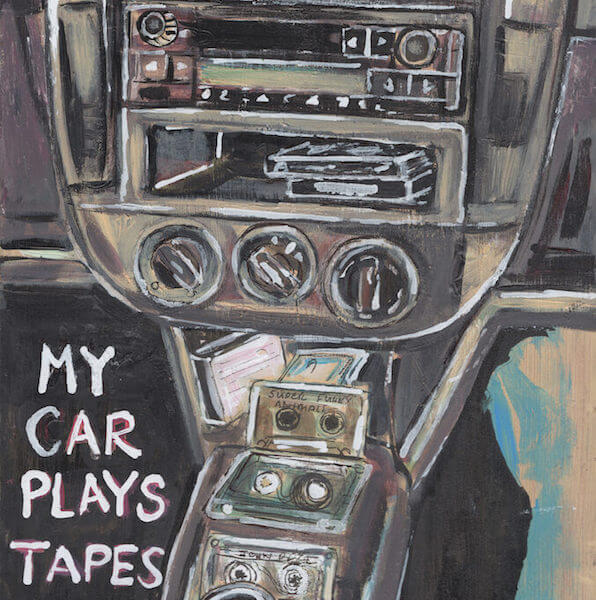
Writer: John Osborne
Talk about nostalgia. The theatre now known as The Space used to be a church. During the short run of My Car Plays Tapes its Victorian bricks must be wallowing in memories. The show sounds like an exceptionally well-written and well-delivered sermon.
John Osborne, the writer and storyteller, even looks spiritual. Sort of. Imagine a Raphael angel who frequents pubs and eats crisps. The set, consisting of a folding table and a few old-school devices, looks like the next generation version of Krapp’s Last Tape, but this has none of that play’s bitterness and self-importance. Instead it’s a series of gentle stories that drift into each other, a celebration both of nostalgia and of the kindness of strangers.
Osborne tells us that he wrote it before the pandemic, when you could walk into a pub with ‘no political, social and moral dilemmas.’ His stories recall an old life when problems were reassuringly normal, and everything got fixed. A woman with special needs gets better housing, an unhappy seventeen-year-old gets her dream job, and when his own car breaks down someone helps him. That spectacular demise – he describes a dramatic lightshow on the dashboard – leads to him acquiring the idiosyncratic tape-playing car. He tells the story in his characteristic self-deprecating and utterly relatable way: ‘You know when something is entirely your responsibility – and you haven’t a clue what to do?’
If the show sounds to the walls like a sermon, it’s partly because of the calming cadences of Osborne’s musical voice, and partly because of the uplifting stories he tells. He’s not preaching at all, just providing examples of good deeds that make the world seem a better place. This is someone who ‘really liked being a teenager’, and spent hours recording songs he liked onto cassettes, which lingered for years in his father’s house. Visiting his father to collect them, he stays for a companionable tea, and they hug each other goodbye. There’s no conflict between them – it’s a normal, taken-for-granted family relationship.
The show is comforting but never for a moment dull. Osborne enjoys vicarious celebrity in the bar of the Soho Theatre and his own celebrity in rural church halls. He is entertaining about his country engagements – giving specific details, including names – ‘there’s always a man called John Bailey’. People, he seems to say, are similar in their differences.
It all feels like something you might happen to hear on Radio 4. This is not surprising as Osborne writes for that station. In a way it would even be better on radio. The set is designed so that Osborne has to keep looking to the side to check his script, which is distracting at first; also the sound quality of those eighties and nineties tapes is not great. However, radio can’t give us Osborne’s engaging smile and comical expressions. He has a face that tells you all will be well.
Poignantly, Osborne opens with a scene in a pub with his ‘adorable chubby middle-aged friends ‘(more angels), at a time when they’d ‘never known the world to be as horrible as it was’. Whenever that time was – how we miss it now.
Runs until 5 March 2022
