

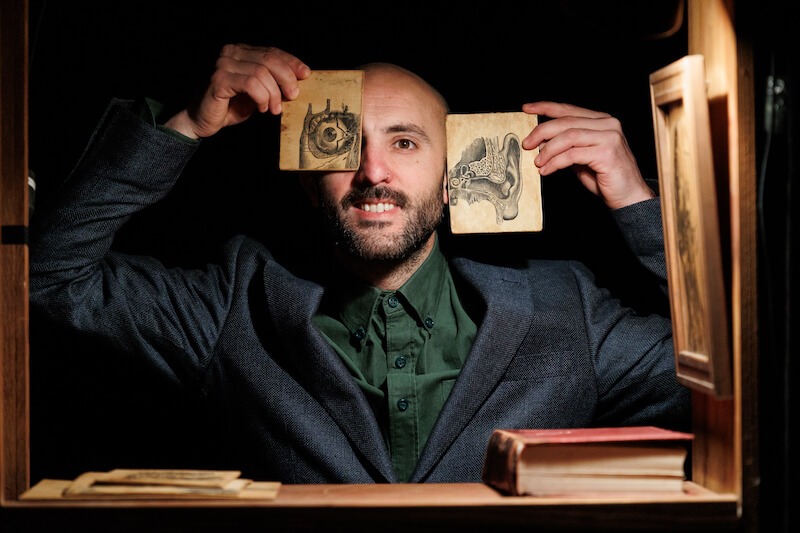
Creators and Directors: Izaskun Fernández and Julián Sáenz-López
A journey into the human body, Izaskun Fernández and Julián Sáenz-López’s Entrañas (Insides) is part biology seminar, part theatrical musing on the complex physiology and emotional responses that shape who we are. Performed in the Barbican Pit Theatre as part of MimeLondon, Entrañas (Insides) takes the audience from the creation of atoms and cells over millions of years, to birth, illness, dreams and death, revelling in the wonder of our composition and the different kinds of love that feed through a life.
There is something of the nineteenth-century natural history enthusiast about this production with its detailed anatomical drawings and glass-boxed organs used to showcase the working skeleton, tissues and muscular structures that exist beneath the skin of the performers, and there is plenty of instructive insight into the way these are held against their bodies. On a structured stage set designed by El Patio Teatro, there are matching nooks for performers Fernández and Sáenz-López to deliver separate chapters as well as central space for larger demonstrations and the show’s key set pieces.
As the title suggests, Entrañas (Insides) is not interested in the physical surface at all and, despite a brief mention of skin, the show focuses entirely on the invisible interior of the body, finding considerable wonder in the enduring physical structures and the less tangible origins of nightmares and emotions that emanate from the brain. As well as a birth-to-death timespan, the piece is also punctuated by segments devoted to our chemical composition, water, bones, scars and the mechanical connections that motor it all, relayed as reams and reams of facts.
This presentational style feels like a lighter Royal Society Lecture, presenting all of this information in an accessible way, but it means the theatricality of the show is often secondary to its scientific value. Both Fernández and Sáenz-López draw in personal family stories that bring some of these concepts to life and Entrañas (Insides) would benefit from more of these. So, while this celebrates the collective notion of the uniform body we all share, the drama and spark exists within the quirks and foibles of individual bodies and how we utilise, respond to and feel differently within them.
The creators use a bit of puppetry, some role play and plenty of props to illustrate the story they want to tell about human interiors and in a 50-minute show, each section is necessarily brief, and one of the themes is the ways in which the body still defies scientific and medical knowledge in the origins of its functions and responses. There could be clearer delineation between physical function and the deeper, more existential mysteries of emotions and imagination and here theatrical techniques would be better suited to exploring how those unanswered questions about behaviour are put into daily practice.
Nonetheless, Entrañas (Insides) has an enjoyable, educative value that seeks to deepen rather than explain what we are, how we are made and what a body is.
Runs until 10 February
