

Writers: Lawrence Valin, Marlène Poste and Malysone Bovorasmy
Director: Lawrence Valin
At first, it may seem that Lawrence Valin’s slightly fantastical film about Tamils in Paris is doing the Sri Lankan diaspora a disservice. In Valin’s colourful vision, this corner of the French capital is brimming with extortionists, people smugglers, boy racers and the odd murderer. As well as directing, Valin plays Michael, the undercover cop assigned to infiltrate the Killi’z organisation, which is sending money back to Sri Lanka to fund the Tamil Tigers fighting against Government troops.
Finding a job in a Tamil café in La Chapelle, the Little Jaffna of the title, Michael’s nickname is Whitey, perhaps for two reasons; he has vitiligo on his face (done convincingly with make-up, although Valin does have the condition elsewhere on his body) and because he acts more like a Frenchman than a Sri Lankan. Instead of using his hand to eat, Michael prefers cutlery. However, to be accepted in the Killi’z gang, he discovers that to fit in, he should ditch the fork.
When he proves handy with his fists, Michael is noticed by Puvi, one of the gangsters, and Aya, the head honcho. Taking Michael, who acts like a slow-witted innocent while undercover, under his wing, Aya tells him to be more discreet. It’s an ironic moment as Aya has just killed a man with a cricket ball on top of his compound, overlooked by high-rises in the setting sun.
Michael’s French identity means that Aya never trusts him completely. No one mentions the vitiligo, but it symbolises a double self that is nevertheless neither French nor Sri Lankan enough. Michael lives with his grandmother, who speaks only Tamil and keeps a shrine to the Virgin Mary in the living room, but at the same time is eager that her grandson be fully ingrained into the French culture. When members of the Killi’z gang arrive at the front door, she is drawn into Michael’s subterfuge, although surely the French police would have prohibited this in real life.
As Michael becomes more deeply involved in the gang’s activities – transporting immigrants into the city and organising the cash that is to be sent back to the Tigers – the film’s ending is never in doubt. He is torn between two cultures, and he can recognise that the Tamil Tigers are fighting for a land that was once theirs, and, therefore, his. But he also wants the privileges afforded to white people.
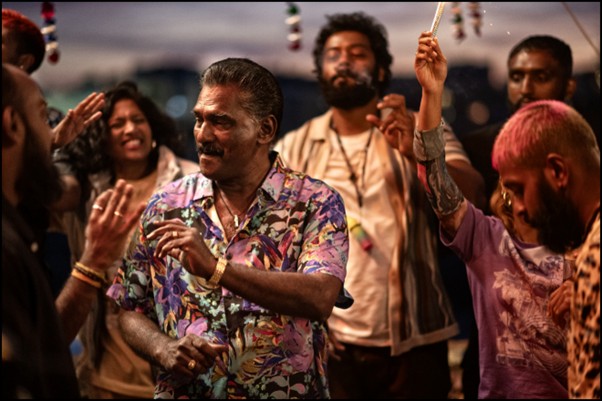
If Michael is caught between two worlds, so is the film. For all their violence and threats, Puvi and Aya are still human, best demonstrated when the former falls in love with a woman he’s not allowed to marry and when the latter is presented with a gaudy shirt for his birthday. As director, Valin is confused as his protagonist, shifting from joyous celebration of the Killi’z community to highlighting its illegal undertakings.
And the film sways between arthouse shots like the one where Michael sits in a tractor on a stage in an empty theatre as water pours down like rain and more traditional action thriller. Little Jaffna never really knows what it wants to be, and while that is probably the intention, the police plot seems a little superfluous. While made on a small budget, most money seems to have been spent on Michael’s vivid clothes, right down to his silver manbag. It’s almost inconceivable that he can fit such a big wardrobe in the bedroom he shares with his grandmother.
With an almost entirely Tamil cast, and working with famous Indian actors Vela Ramamoorthy (who plays Aya) and the brilliant Radhika Sarathkumar (who plays Michael’s grandmother), Valin has created a film about immigrants that is miles away from La Haine and the more recent films, Les Misérables and Les Indésirables by Ladj Ly. Little Jaffna is certainly more colourful and perhaps more ambiguous.
Little Jaffna is on UK and Ireland digital platforms 15 September 2025
